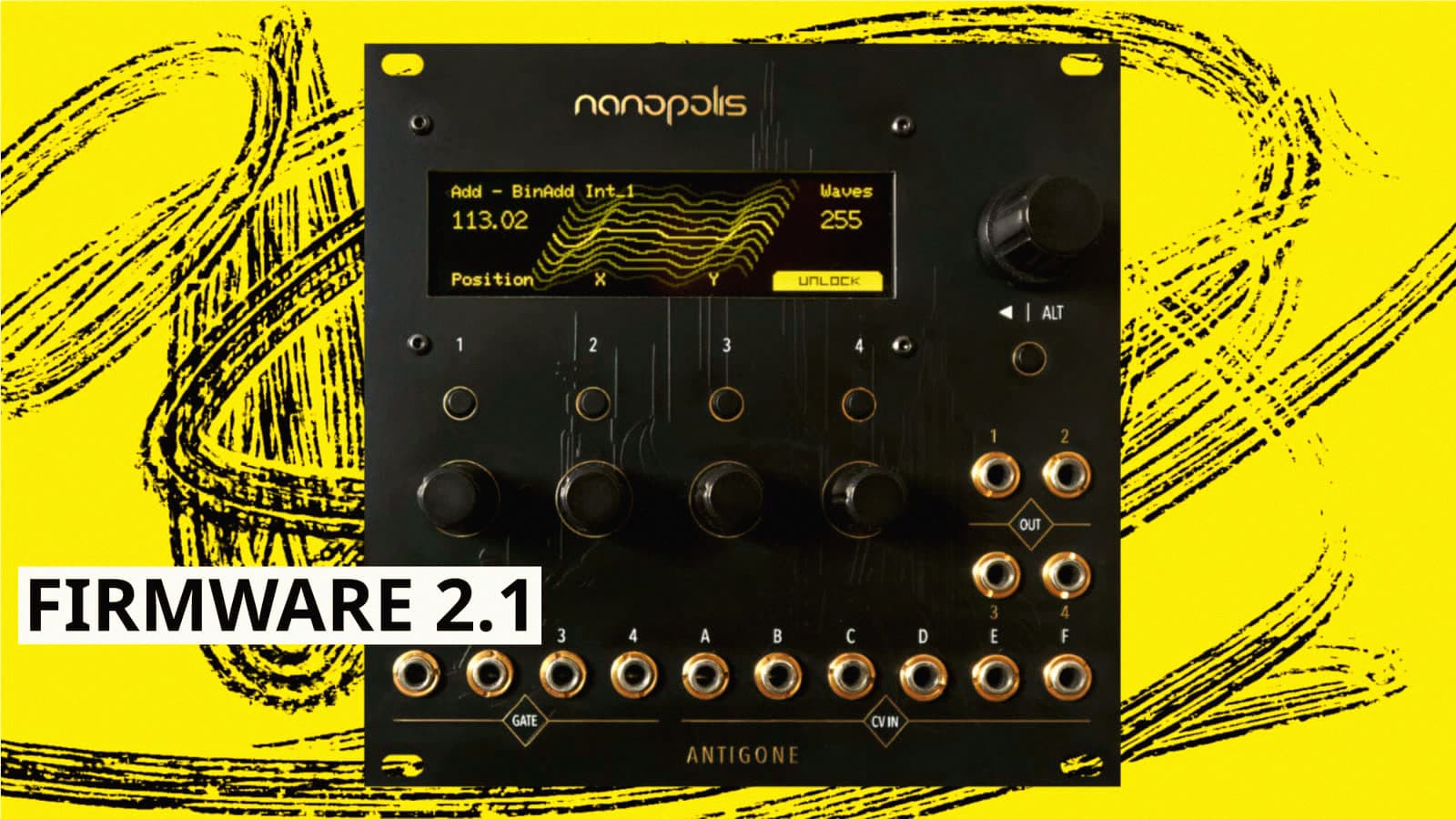
Nanopolis built Antigone as three instruments wearing one 26HP faceplate: a polyphonic synth, an oscillator bank, a drum machine. Firmware 2.1 does not add a fourth. It makes the first three deeper, and the headline move is folding in someone else's engine.
Why borrow Plaits instead of building a clone?
Mutable Instruments' Plaits is the most studied macro-oscillator in modular synthesis: eight synthesis models stacked into one chip, copied in spirit by half the Eurorack market since Émilie Gillet open-sourced the design. Nanopolis skips the imitation step and licenses 16 of the real algorithms directly, routed through Antigone's own voice architecture with selectable main and auxiliary outputs per voice. That means a producer can run a Plaits-style wavetable scan on the primary output while tapping its auxiliary signal, a formant or noise layer, into a second channel for parallel processing, something the original Plaits hardware never offered on its own. Stack that across Antigone's six voices and you get six independent Plaits-flavoured engines, each with its own filter, saturation and modulation chain on top, a scale no standalone Plaits module can touch.
The update pairs that with seven in-house oscillator types: Scan and Terrain lean toward wavetable and terrain-synthesis textures, Fdbck chases the screaming feedback FM sound JP-8000 users will recognize, DSF stacks discrete summation formula partials up to 64 deep for dense inharmonic tones, and Polygon, Fractal and Neural push into geometric and generative waveshaping. Combined with the Plaits set, that is 23 new ways to generate a waveform before a single filter or resonator touches it.
What does the resonator and granular side actually add for sound design?
Nanopolis doubled the granular engine's density to 32 grains per voice, which is the difference between a granular cloud that sounds like discrete particles and one that blurs into a continuous, textured drone, useful for anyone building ambient pads or glitch percussion from sampled material. The 17 new resonator models, handpan, steel pan, prism, electric piano, choir, bloom and acoustic guitar among them, extend Antigone's physical-modeling side past drums into melodic acoustic timbres, and the update lets a resonator be excited from two sources at once rather than one, so a noise burst and an oscillator can hit the same virtual body simultaneously for hybrid acoustic-electronic hits.
Two exciters per resonator, new acoustic percussion, Plaits oscillators, spring reverb and per-output compression and limiting arrived together in 2.1.
Nine new drum models, including tabla, frame drum and idiophone, sit alongside the ability to choke a ringing hi-hat the way a drummer's foot would. Spring reverb and per-output compression and limiting land on the output stage, and auto-save finally protects a patch built over a long improvisation session from a crash or a pulled power cable.
Who is this actually for?
Antigone was already a dense box: two oscillator slots with 43 models each, nine filter types across 28 variants, 29 saturation and distortion algorithms. Firmware 2.1 does not simplify any of that, it adds to it, and it is aimed squarely at users who already own the module and want more synthesis territory inside the same 26HP rather than buying a second voice box. For anyone shopping, it raises the bar Antigone was already clearing: a free update that absorbs a competitor's flagship engine is not something most Eurorack manufacturers do.