Diego Capoccitti dropped OktaDie on August 6, and within its first press cycle the plugin was already being talked about less as a new instrument than as a stand-in for one nobody can get their hands on. SOMA Laboratory's Lyra-8, the Moscow-designed hardware drone machine that built a cult following in ambient, techno and organic-house circles for its touch plates and chaotic, self-oscillating voices, typically lists around $750 to $800 when it's even in stock. OktaDie is $9.99 on desktop.
What does OktaDie actually do?
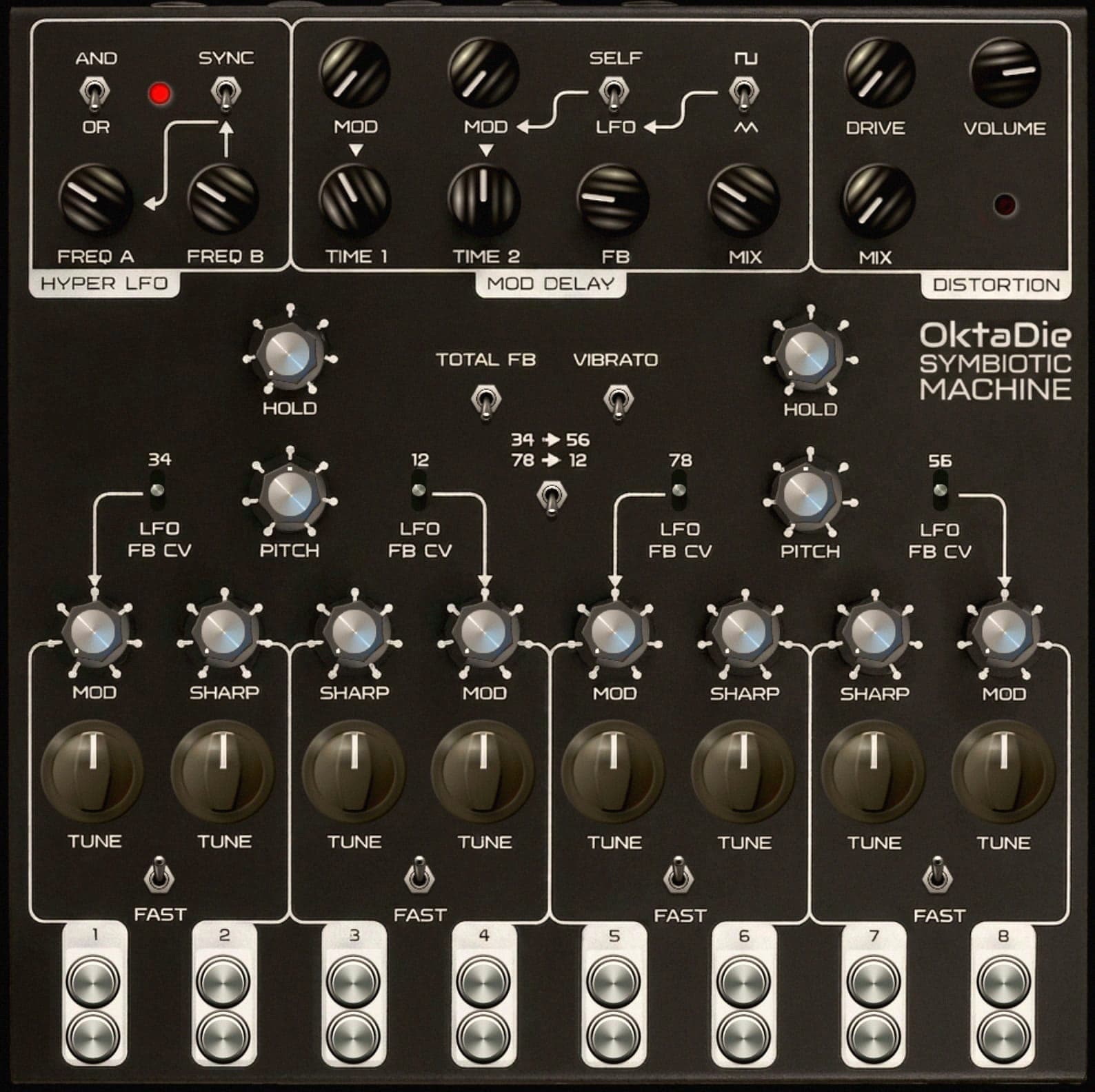
The plugin runs eight non-linear voice generators, split into four pairs across two groups, the same organizing logic the Lyra-8 uses for its eight touch-triggered oscillators. Each voice pair gets its own tune, mod and shape controls, with continuous untempered tuning that lets drones drift out of a fixed scale entirely, no keyboard or quantization required. A cross-modulation matrix lets the voices feed into each other for FM-style textures, and a Hyper LFO combines two LFOs through AND and OR logic to generate rhythmic gating that would take real patch-cable work on the original hardware. On top sits a lo-fi noisy delay with cross-feedback that can self-oscillate, and a drive stage with parallel mixing for grit without losing the dry signal. Sixty-one factory presets and full MIDI support, including velocity, aftertouch, pitch bend, CC1 vibrato and MPE, round it out. Capoccitti also ships a second plugin in the same package, a standalone FX processor that runs the delay and drive chain on any external audio source.
Inspired by, or an emulation of, the Lyra-8?
Capoccitti is upfront about the lineage. "Emulating the Lyra-8 is not easy," he says of the design process. "It has a very distinctive organic raw sound that is difficult to imitate." That word, emulating, is doing more work than his marketing copy admits: his own shop page calls OktaDie "inspired by" the SOMA hardware, but the voice-pair structure, the touch-style control scheme and even the two-group layout map onto the Lyra-8 almost one to one. It is not a legal question, there is no indication SOMA is involved or objecting, and software developers modeling a beloved circuit's behavior is as old as the plugin business itself. But calling it merely "inspired by" undersells how deliberately OktaDie is built to feel like sitting in front of the real thing.
"It has a very distinctive organic raw sound that is difficult to imitate."
Does the price gap actually matter here?
For plenty of ambient, drone and organic-house producers, yes. The Lyra-8 has spent years drifting in and out of stock at SOMA and its retailers, and at $750 to $800 it's a serious commitment for a niche, single-purpose instrument. OktaDie won't replicate the exact analog quirks of the hardware, and touch-plate feel doesn't translate one to one to a mouse or touchscreen, but $9.99 for the desktop plugin (or $14.98 if you also grab the $4.99 iOS version for a phone or iPad) buys a genuine attempt at that chaotic, semi-generative drone workflow without waiting on a restock notification.