Plaits spent four years as the single most-patched module on ModularGrid, the de facto brain of thousands of Eurorack techno rigs, before Mutable Instruments founder Emilie Gillet discontinued the whole product line in 2022. Getting its sound meant finding a used unit or waiting on a group buy for one of the many hardware clones. Now you can skip the rack entirely.
What exactly is Plaits, and why does its code matter?
Plaits is a macro oscillator: one small module that folded in the synthesis engines of several earlier Mutable Instruments modules (Braids, Rings, Elements, Clouds) into 16 HP of panel space, then grew to 24 distinct algorithms over its firmware updates. What made it more than another sought-after discontinued module is that Gillet released its full DSP source code under the MIT License, one of the most permissive open-source terms available: anyone can take it, modify it and ship it, commercially, as long as the original authorship is credited. Mutable Instruments never stopped anyone from building on Plaits after pulling it from sale, and plugin maker Push and Groove just did exactly that.
What does Micronix actually do?
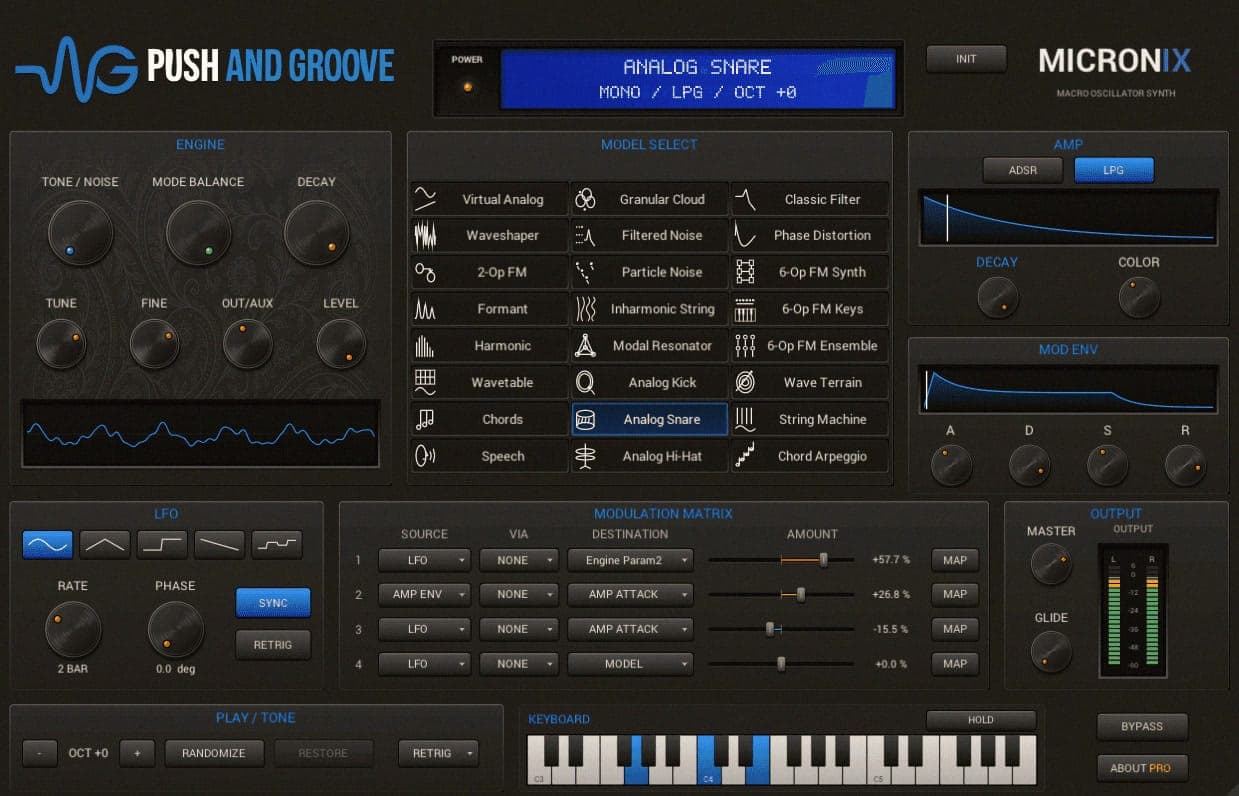
Micronix drops Plaits' own synthesis code into a standard DAW plugin window. All 24 models are there, from the FM and wavetable engines to the granular cloud and the physical-modeling and percussion algorithms that made Plaits useful as a standalone drum voice, each reduced to the same three macro knobs Plaits users already know: Harmonics, Timbre, Morph. Push and Groove built around that core with five LFO shapes that sync to host tempo and can retrigger per note, a four-row modulation matrix for routing them (and other sources) to any parameter, and a choice of ADSR or low-pass gate envelopes, the latter being the same percussive, filter-plus-amp behavior that let the original module work without an external VCA or VCF.
All 24 of Plaits' synthesis models, running as a free plugin, with the macro layout Eurorack users already know by heart.
What's the catch?
There is one, by design. The free Micronix is strictly monophonic with a single synthesis engine active at a time, the same constraint the original hardware module had before anyone started layering two side by side. Push and Groove sells Micronix Pro for players who want a second engine running in parallel and genuine polyphonic playback, the two upgrades the free build deliberately leaves out. It is a conventional freemium split, not a bait-and-switch: the free version is the full Plaits algorithm set, not a cut-down demo of it.
Why it matters
Plaits shaped a chunk of modern modular techno's sonic palette, but it always had a price floor: a case, power, patch cables, and roughly $300 before a single sound came out. Micronix drops that floor to zero and puts the same algorithms inside Ableton, Logic or any VST3/AU host, which means a much larger share of producers can now reach for that specific Plaits texture without ever buying a rack.
What we think
This is open-source hardware working exactly as it should: Gillet gave the code away, and someone else turned it into a tool more producers can actually use. The free/Pro split is fair, Push and Groove isn't gatekeeping the core sound, just the convenience features, and that's a model more plugin makers building on open modular DSP should copy.