Numerical Audio has released MIDIRack, a modular MIDI toolkit for iPadOS that treats a touch control surface the way a modular synth treats a patch bay: build it from blank, patch it however you want, and change your mind tomorrow. It's the follow-up to the developer's KB-1 Expressive Keyboard Suite, and it folds all six of that app's keyboard layouts, velocity-sensitive piano, diatonic chord pads, a scale-locked keyboard, an MPE ribbon, an MPE Strings grid and a 4x4 drum pad grid, into a bigger box of parts.
What can you actually build on the touch surface?
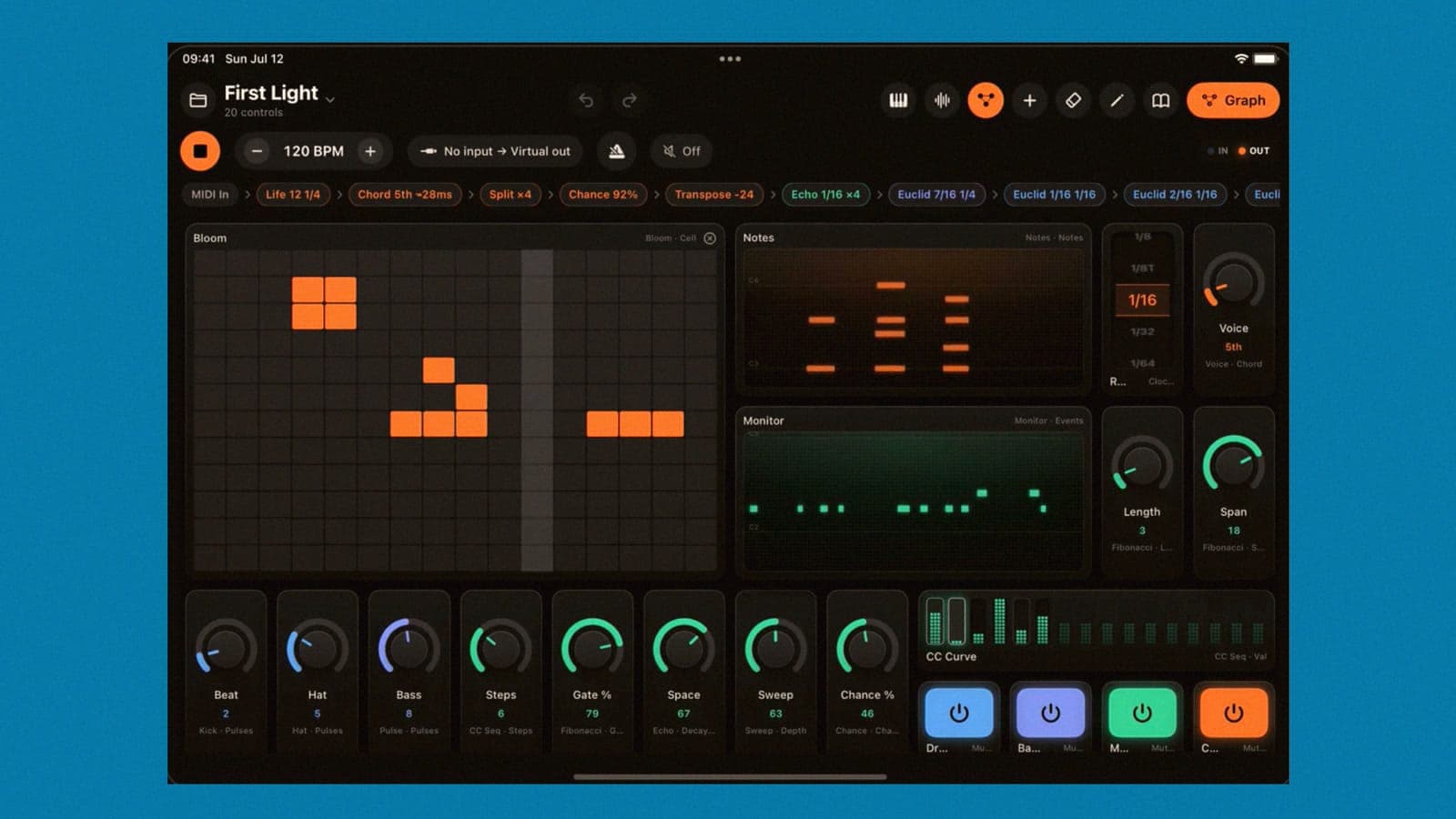
MIDIRack drops you on a snapping grid and lets you drag in keyboards, four kinds of step sequencer (drum, melody, chord and CC lanes, plus an analog-style matrix grid with a moving playhead), knobs, faders, XY pads and buttons, then wire each one to send MIDI to any synth, app or piece of outboard gear. Steps carry velocity, probability, tie, trigger conditions and microtiming, and the whole surface runs standalone or as an AUv3 MIDI processor inside Logic Pro, Ableton Live, Bitwig, AUM, GarageBand, Cubasis, Drambo and Loopy Pro, over USB (Apple's IDAM) or Bluetooth, no drivers needed. For anyone who has ever bought a hardware controller and then spent six months wishing three of its knobs did something else, that is the pitch: the layout is the instrument now, not a fixed panel you adapt your set to.
Why does the node-graph processor matter for a live rig?
The bigger idea sits in the optional Graph Editor, a separate in-app purchase that turns MIDI processing into a visual patching canvas. You wire MIDI In to MIDI Out through more than 60 nodes: arpeggiators, scale and key quantizers, transpose, chord, echo, ratchet, humanize, swing, euclidean rhythms, LFOs, envelopes, sample and hold, CC tools and generative engines including Turing machines, Markov chains and Conway's Game of Life. That is a rack of Eurorack-style MIDI utilities living inside a $7.99 app, and it means the kind of humanized, generative, rhythmically displaced MIDI that used to require a shelf of hardware modules (or a laptop full of Max patches) is now something you build on a tablet between soundchecks.
How does this fit into an existing DJ or live-electronic setup?
None of this needs a rack of gear to matter. Plug an iPad into a laptop over USB and MIDIRack becomes a control surface for Ableton, Bitwig or Logic that you designed yourself, not the one a manufacturer decided everyone needs. Route a euclidean node into a hardware synth over Bluetooth mid-set, or build a stripped-down performance layout with just the pads and knobs a specific track needs, and you have swapped a $300 to $600 hardware controller (and its fixed layout) for a $15.98 software rack you can redesign the night before a gig. It will not replace a CDJ, but for the growing pool of DJs and live-electronic acts running hybrid sets off an iPad, it closes a real gap: custom MIDI hardware from scratch, without a soldering iron.